SOTA
SUMMITS ON THE AIR
SOUTH AFRICA
mt Coolum 12 March 2015
Disclaimer
Hiking and mountain climbing are potentially hazardous activities. The SOTA Management
Committee, the South African Association and their officers do not accept responsibility for any
death or injury resulting from participation in SOTA. The inclusion of a summit in this reference
Manual does not indicate that it is safe or even possible to climb the summit. The summitreference data is not guaranteed to be accurate and no reliance should be placed upon it.
INDEX
- Introduction
- Safety
- Snake bites
- SOTA
- Short Stories and photos
Introduction
As is so true of amateur radio itself, there are many variations of SOTA activating, which allow it to be as easy or as difficult as you wish it to be. It has been said many times and is now generally accepted, that SOTA is not a level ‘playing field.’ Thank goodness it isn’t! If it were so, there wouldn’t be the breadth and variation of targets available for participants of all ages and abilities from the barely mobile to the mountaineer / expeditionary. Yes, from the outset SOTA has been carefully designed so as to offer something for everyone and becoming a successful activator is most definitely not limited to the super-fit. Where’s the evidence? There are quite a few disabled activators and at least one successful blind summiteer! One operator’s father attended an activation of G/NP-028, when aged 90, even sending a greetings message! At the top of the abilities pyramid, there are seasoned mountaineers but there are also Mountain Goat Award holders who scarcely set foot on a hill before SOTA came along in 2002. The important prerequisites are enthusiasm, the possession of an amateur radio licence and a love of the open-air.
Safety FIRST
Safety is the single most important aspect of outdoor activities in South Africa, not only when activating a summit but also when hiking through our forests and bush land
Always ensure that you tell someone where you are going and your estimated time of return,
- Plan you trip: make sure you know the area where you will be hiking
- Find out what dangers could be encountered, speak to the local hiking clubs surf the internet for as much info as possible
- As snakes are always around, find out the types could be found in that area get to know the basic s of snake bit treatment, ensure you have the correct contact details in case of emergencies
- Ensure you have the correct and appropriate clothing, boots wet weather clothing and something warm the weather on a summit can change rapidly
- Make sure you have adequate water and food
When someone is bitten by a snake:
Make sure that everyone is safe. Do not attempt to kill or capture the snake, it might strike again.
- Try to identify the snake – get a good description or take a picture with your cell phone if it is safe!
- Keep the victim calm. Stress and fear increases blood flow, spreading the venom more rapidly.
- In case of a Cape cobra or mamba bite, you might want to apply a wide pressure bandage above the bite site to slow the spread of venom to the heart and lungs. NEVER use this on viper or adder bites, since it causes swelling and the bandage will cause more damage.
- Call for help immediately or take the victim to the closest emergency room. You should know where your local anti-venom is being kept and take the victim to that hospital directly – do not waste valuable time for the anti-venom to come to you. Call the hospital on route to inform them of your arrival.
- Take someone who knows CPR with you – since the life-threatening symptoms of some bites can start as early as 30 minutes after the bite, CPR might have to be administered.
- Always keep the bitten limb below the heart – it slows blood flow and the spread of venom.
- Very important: Do not give the victim anything to eat or drink, especially alcohol! Alcohol will actually speed up the absorption of venom.
- Snake bites are very painful, but do not give any pain medication unless a doctor tells you so.
- The bitten limb may swell, so remove all constricting clothing, jewelry or shoes.
Never:
- Never cut into the bite site. Snake experts warn that doing this may cause further damage and increase the risk of infection.
- Never suction any venom. Research has shown that suction applied 3 minutes after a bite only removes about 1/1000th of the venom injected! Suction by mouth can be dangerous as venom may enter the mouth via a wound.
- Never apply a pressure bandage if you don’t know what snake it is and what the effect of the venom is. Some snake bites cause extreme swelling and applying a pressure bandage can do more harm than good.
- Never apply a tourniquet.
I asked leading snake expert Dr Brian Grieg-Fry what to do in the event of a snake bite and his first and only answer was: Always keep your cell phone charged and never go anywhere without it. Save the numbers of your nearest poison center, hospital and doctors on your phone – you never know when you might need it.
Special thanks:
Mariette Pressley
Tygerberg Hospital Poison Centre
Dr Bryan Grieg-Fry
Useful resources:
- Spiders and spider bites
- What is a
snakebite?
- Poison Information Centre
- Venomous snakes
of the Cape Peninsula
- African Reptiles
& Venom
- South African Vaccine Producers
- Johan Marais – Snakes and Snake Bite in Southern Africa
Poisons Information Helpline of the Western Cape: 0861 555 777 (24 hours)
Take a look pictures of different African snakes in this handy website, Snakes of South Africa.
SOTA Activities
SOTA chasing is one of the fastest growing specialist interests in amateur radio today.
Unlike the activators who climb mountains and make QSO’s, the chaser doers not require any specialist equipment or fitness to get started and in most cases your existing equipment will allow you to start earning points. SOTA stations use a wide selection of operating bands and modes, including 2m FM, 2m SSB, HF SSB, HF CW and even 10 GHz.
Your home QTH will have an effect on your choice of bands and modes. If you live close to mountains then you can have considerable success with a 2m FM station and a simple antenna, working activators in your own country. However SOTA is international and you can contact activators throughout Europe and beyond if you have access to the HF bands.
The number of points gained for a contact depends on the height of the summit and each summit has a reference number. Activators issue alerts on SOTAwatch to let you know the times and frequency when a summit is due to be activated.
Certificates are awarded for 100 points and upwards. Good Luck and welcome to the fascinating world of SOTA chasing.
Introduction to Activating
As is so true of amateur radio itself, there are many variations of SOTA activating, which allow it to be as easy or as difficult as you wish it to be. It has been said many times and is now generally accepted, that SOTA is not a level ‘playing field.’ Thank goodness it isn’t! If it were so, there wouldn’t be the breadth and variation of targets available for participants of all ages and abilities from the barely mobile to the mountaineer / expeditionary. Yes, from the outset SOTA has been carefully designed so as to offer something for everyone and becoming a successful activator is most definitely not limited to the super-fit. Where’s the evidence? There are quite a few disabled activators and at least one successful blind summiteer! One operator’s father attended an activation of G/NP-028, when aged 90, even sending a greetings message! At the top of the abilities pyramid, there are seasoned mountaineers but there are also Mountain Goat Award holders who scarcely set foot on a hill before SOTA came along in 2002. The important prerequisites are enthusiasm, the possession of an amateur radio license and a love of the open-air.
In order for you to participate in the activation or chasing of a summit, all possible summit had to be mapped for each of the provinces, to date the date base is as follows
Eastern Cape ZS/EC 874
Eastern Cape Lowlands 263
KWI ZULU Natal ZS/KN 447
Western Cape ZS/WC 969
Northern Cape ZS/NC 785
Free State ZS/FS 193
Limpopo ZS/LP 558
Mpumalanga ZS/MP 222
Gauteng ZS/GP 14
North West ZS/NW 969
Each summit has been allocate a specific reference number eg ZS/FS 001 with where possible the available summit name coordinates, all summit reference numbers can be obtained by visiting the SOTA website at www.sota.org.uk
Awards
Each summit is assigned a number of points between 1 and 10. In some countries a seasonal bonus of 3 points per summit helps the score along. Certificates for 100, 250, 500 and 1000 activator points are available but if you reach 1000 points, you can obtain an attractive ‘Mountain Goat’ trophy with your call sign inscribed on it. In case you’re tempted to hang up your boots after attaining the 1000 level, further certificates are available at 2500, 5000 and above!
Find your own level
Starting out in SOTA activating can be a little like buying a new suit. The tailor makes measurements and a start is made on production. At stages there will be fittings where adjustments can be made. By the end of the process the suit should fit perfectly (until you put on weight, that is!) If you have little experience of either or both of the basic components of SOTA activating (i.e. hill-walking & portable operating) you will to some degree, be on a learning curve. Your first tentative outing might not go exactly to plan but don’t be discouraged. With a little patience, a few adjustments and perhaps some advice from ‘old hands,’ there is likely to be an activating style that fits you personally, suits your pocket and sharpens your skills; bringing enjoyment beyond your imaginings.
Many activators set their sights on the coveted Mountain Goat Award but that’s not for everyone. If you live far from the hills, suffer a disability or have little leisure time, it’s best to set your own achievable targets at first, such as activating all the lower hills in your own area or selecting the ones where there is good road access etc. Equally, the more experienced might want to limit their efforts to the highest mountains. The really important thing is that you join in, enjoying the challenge and ‘buzz’ that you’ll get from eager chasers desperate to work ‘your’ summit for the points or ‘falling over themselves’ to log a ‘new one’ or ‘unique’ regardless of how big it is.
Special thanks:
Mariette Pressley
Tygerberg Hospital Poison Centre
Dr Bryan Grieg-Fry
Useful resources:
- Spiders and spider bites
- What is a
snakebite?
- Poison Information Centre
- Venomous snakes
of the Cape Peninsula
- African Reptiles
& Venom
- South African Vaccine Producers
- Johan Marais – Snakes and Snake Bite in Southern Africa
Poisons Information Helpline of the Western Cape: 0861 555 777 (24 hours)
Take a look pictures of different African snakes in this handy website, Snakes of South Africa.
SOTA Activities
SOTA chasing is one of the fastest growing specialist interests in amateur radio today.
Unlike the activators who climb mountains and make QSO’s, the chaser doers not require any specialist equipment or fitness to get started and in most cases your existing equipment will allow you to start earning points. SOTA stations use a wide selection of operating bands and modes, including 2m FM, 2m SSB, HF SSB, HF CW and even 10 GHz.
Your home QTH will have an effect on your choice of bands and modes. If you live close to mountains then you can have considerable success with a 2m FM station and a simple antenna, working activators in your own country. However SOTA is international and you can contact activators throughout Europe and beyond if you have access to the HF bands.
The number of points gained for a contact depends on the height of the summit and each summit has a reference number. Activators issue alerts on SOTAwatch to let you know the times and frequency when a summit is due to be activated.
Certificates are awarded for 100 points and upwards. Good Luck and welcome to the fascinating world of SOTA chasing.
Introduction to Activating
As is so true of amateur radio itself, there are many variations of SOTA activating, which allow it to be as easy or as difficult as you wish it to be. It has been said many times and is now generally accepted, that SOTA is not a level ‘playing field.’ Thank goodness it isn’t! If it were so, there wouldn’t be the breadth and variation of targets available for participants of all ages and abilities from the barely mobile to the mountaineer / expeditionary. Yes, from the outset SOTA has been carefully designed so as to offer something for everyone and becoming a successful activator is most definitely not limited to the super-fit. Where’s the evidence? There are quite a few disabled activators and at least one successful blind summiteer! One operator’s father attended an activation of G/NP-028, when aged 90, even sending a greetings message! At the top of the abilities pyramid, there are seasoned mountaineers but there are also Mountain Goat Award holders who scarcely set foot on a hill before SOTA came along in 2002. The important prerequisites are enthusiasm, the possession of an amateur radio license and a love of the open-air.
In order for you to participate in the activation or chasing of a summit, all possible summit had to be mapped for each of the provinces, to date the date base is as follows
Eastern Cape ZS/EC 874
Eastern Cape Lowlands 26
KWI ZULU Natal ZS/KN 447
Western Cape ZS/WC 969
Northern Cape ZS/NC 785
Free State ZS/FS 193
Limpopo ZS/LP 558
Mpumalanga ZS/MP 222
Gauteng ZS/GP 14
North West ZS/NW 969
Each summit has been allocate a specific reference number eg ZS/FS 001 with where possible the available summit name coordinates, all summit reference numbers can be obtained by visiting the SOTA website at www.sota.org.uk
Awards
Each summit is assigned a number of points between 1 and 10. In some countries a seasonal bonus of 3 points per summit helps the score along. Certificates for 100, 250, 500 and 1000 activator points are available but if you reach 1000 points, you can obtain an attractive ‘Mountain Goat’ trophy with your call sign inscribed on it. In case you’re tempted to hang up your boots after attaining the 1000 level, further certificates are available at 2500, 5000 and above!
Find your own level
Starting out in SOTA activating can be a little like buying a new suit. The tailor makes measurements and a start is made on production. At stages there will be fittings where adjustments can be made. By the end of the process the suit should fit perfectly (until you put on weight, that is!) If you have little experience of either or both of the basic components of SOTA activating (i.e. hill-walking & portable operating) you will to some degree, be on a learning curve. Your first tentative outing might not go exactly to plan but don’t be discouraged. With a little patience, a few adjustments and perhaps some advice from ‘old hands,’ there is likely to be an activating style that fits you personally, suits your pocket and sharpens your skills; bringing enjoyment beyond your imaginings.
Many activators set their sights on the coveted Mountain Goat Award but that’s not for everyone. If you live far from the hills, suffer a disability or have little leisure time, it’s best to set your own achievable targets at first, such as activating all the lower hills in your own area or selecting the ones where there is good road access etc. Equally, the more experienced might want to limit their efforts to the highest mountains. The really important thing is that you join in, enjoying the challenge and ‘buzz’ that you’ll get from eager chasers desperate to work ‘your’ summit for the points or ‘falling over themselves’ to log a ‘new one’ or ‘unique’ regardless of how big it is.
Let’s get the serious stuff out of the way first…
The topics following, which are pertinent to safe SOTA activating, are detailed in Winter Safety Notes (for the SOTA newcomer.) Please read it.
The Weather
If you’re not used to the high places, conditions may surprise you; especially in winter. Suffice to say that valley and summit weather is ‘like chalk & cheese.’ You can expect a temperature drop of 2 deg. C for every 300m (1000 ft) of ascent, perhaps double or treble the wind speed / wind-chill and a high degree of changeability – in the UK and many other mountain areas the weather can change from bright and breezy to a full blizzard in a few minutes. If you didn’t properly prepare for your first ever SOTA sortie, adding low-cloud and/or precipitation to this cocktail will certainly make you take notice the next time you venture out! Get the latest forecast; if possible a local mountain one.
In summer you should take precautions to avoid de-hydration, sunburn and (on still days) even insect attack. One increasing hazard is the common tick, which lurks in undergrowth (e.g. Bracken). These can carry Lyme disease. In winter, wind-chill is a common enemy but snow, ice; bad visibility and short days should all be taken into account too. Lightning is something to avoid entirely and static could shock you or damage your equipment.
Walking gear
Ensure you have the proper outdoor clothing and footwear including, waterproofs, a hat / hood, gloves, food / drinks, navigational & emergency items including map, whistle, survival bag & first-aid kit. A good rucksack, which need not be huge and rucksack liner will help to safeguard your delicate radio kit. Pack a small torch, spare batteries, emergency rations and a survival bag. Carry a whistle. Your route should be pre-planned and advised in writing to a trusted person, to cover the unlikely occurrence of an emergency. There are still plenty of summits which don’t have mobile phone coverage.
Experience
If you are completely new to the discipline of hill-walking, take an experienced companion and/or start with something small and work up. For more ambitious activity, ensure that you have the knowledge, training, fitness and equipment appropriate to the conditions that you are likely to meet, with sufficient reserve for dealing with unexpected delays and emergencies.
At the summit
Take steps to make yourself more comfortable for the activation. A sit-mat and extra clothing are good for starters but if you’re planning to stay for longer, portable shelters of one type or another are quite popular. Some summits have walls or stone shelters but giving other people as much space and priority as possible is important. Time taken explaining what you are doing is time well spent but you should endeavor to ‘blend’ as much as you can, both in sight and sound. Set up safely, in the least obtrusive manner and use headphones. Do your best to be a good ambassador for the hobby. A leaflet is available to help you but don’t give it away if there’s a chance that it might later be discarded and become litter.
Remember. You are responsible for your own well-being, so whether you’re ‘thinking big’ or merely venturing a short distance from the vehicle, further research into mountain safety is strongly recommended.
Now, on a lighter note.
..Radio kit
Life is full of choices but SOTA activating equipment can roughly be divided up into a few main categories:
VHFM Handie
Perhaps the simplest, lightest, least obtrusive and (if successful) quickest approach is to take along a VHF or UHF Handheld, fitted with a helical antenna. Here SOTA can deliver a real bonus to make modest equipment perform better. On a hilltop, you are likely to enjoy an enhanced ‘take-off’ and contacts can come easily, especially if you’re high up and close to population centers. If you’re a newcomer, 2m-FM can be a good way to ‘test the water.’ However, on smaller hills which are blocked by larger ones and even on many of the more remote Mountains despite a lofty stance, things may not be so straightforward. A ‘rucksack vertical,’ free-standing mast & antenna such as a half-wave or a modest SOTA-beam will help greatly but there’ll still be certain summits from which you’ll struggle to obtain the 4 QSO’s required for qualification.
VHF SSB & Beam The next logical progression is towards the use of VHF SSB gear, a bigger beam, more power and possibly an RX pre-amp. This is likely to uncover ‘another world’ that effectively remains hidden from the 2m-FM operator. Useful distances can now be covered especially during ‘Es’ or ‘tropo’ events but the weight penalty begins to kick in. There are the neighboring bands of 4m, 70cm, 23cm etc. but none likely to succeed so well as 144 MHz. 6m can surprise us at times and a handful find success way up at 10 GHz
HF
SOTA activity is now world-wide and can be found on all HF bands. Activity is controlled by the sunspot cycle, at minimum the main activity is on 40, 30 and 20 meters, at maximum use is made of the higher bands. In the UK the reliable 60m (5 MHz) band has been put to excellent use for SOTA. To operate this band in the UK, a full license is required. Finally, the knowledge that there exists a small group of 160m band SOTA enthusiasts may come as a surprise to many.
If the drawbacks of carrying and setting-up HF equipment can be accepted especially if you plan to run significant power, you arrive at a point where it is possible to literally work the world. However, any temptation to reduce the quantity of essential ‘safety equipment’ to make space for more radio gear should be fiercely resisted; most activators use QRP with surprising success, summit to summit (S2S) contacts have been logged over distances of the order of 17,000 km.
Though on the majority of SOTA tops there is little problem, one important consideration is the space required to accommodate in a sympathetic manner, large wire antennas on busy ‘compact’ summits such as for example, Snowdon (GW/NW-001). Here we should invoke the ’25m activation zone rule’ which exists to help us address this issue and the question of how best to find shelter from the elements.
CW
Since activators have obvious weight & power limitations their use of CW, with its greater reliability in marginal conditions and/or QRP situations, has grown in SOTA as a result. Quite a few summit operators have trained themselves from scratch or brushed up on their Morse. Be they activator or chaser, all have benefited from fuller logbooks and the satisfaction of a new skill turned to good advantage.
Power supply
The most common battery types currently used for SOTA QRP work are Nickel-Metal Hydride and Lithium. Until battery technology truly catches up, offering us lightweight, heavy-current power at affordable prices, many activators are stuck with the popular but heavy SLAB (sealed lead-acid battery – often 7.5 Ah) for use with 100-Watt rigs. It’s worth keeping an eye out at radio rallies, to see what’s available.
Rigs
Obviously, VHF/ (UHF) handheld transceivers are eminently portable and unless its 4m, 6m or the bands above 70cm you’re after, there are plenty to choose from. The more rugged 2m-only or multi-banders, which can run 5 Watts and at least claim to be waterproof, are perhaps the most suitable for first-line use in our branch of the hobby but there are plenty of lighter ones for use in backing-up a primary rig. Running SSB from an old, trusty FT290 through a linear is another viable option. You’ll need an SMA-BNC adaptor to connect an external antenna to the more modern rigs.
Thankfully in recent years, HF transceivers have ‘shrunk’ in size and weight, whilst greatly increasing in usefulness by incorporating the 6m, 2m & 70cm bands. Worthy of mention is the FT817; an HF/VHF/UHF QRP rig which was surely created to revolutionise SOTA operations! The FT857 is similar in many ways but is larger and heavier, it runs 100 Watts, and some SOTA regulars put their IC706’s to good use. The KX3 is becoming popular, and many activators use one of several simple kit-built CW transceivers.
Antennas
For VHF, many people use a lightweight beam. SOTAbeams of Macclesfield make a range of these with masts to go with them. For HF, the trend tends to be towards home-brew using thin wire (perhaps 20, 22 or even 24 AWG) and lightweight coax (e.g. RG 178 or RG316). Link antennas, based on a resonant dipole for the lowest band desired, with pull-apart connectors for the bands above it, have become quite popular. A link dipole, carefully designed and covering the 80m, 40m & 30m bands for example, can weigh less than 400gm including a spool. Roughly an equal number of HF activators carry a miniature (often automatic) ATU to allow matching and multi-band operation using either balanced-line fed doublets or long-wires. Some activators like to use vertical wire antennas on the higher bands for their DX potential.
Antenna support
Many of the masts carried for HF tend to be based on lightweight, sectional GRP fishing-poles, which are usually guyed by one means or another. However, in very high winds the strength of their thin, upper sections can be called into question so these might best be temporarily discarded in such conditions. Shorter adaptations of these are good at supporting VHF beams and a few operators use two walking poles fixed together to form a low center-support for wire antennas. On many lower summits it is possible to put handy trees to good use. Whatever system is used, there are the inevitable compromises between weight, bulk and windage versus performance, durability and height above ground.
What to expect
With the exception of certain hilltops which play host to commercial transmitting equipment, the refreshing low-noise HF radio environment of a typical SOTA summit added to a receiver powered by batteries, has to be experienced to be believed! Here, the HF activator enjoys a huge receive advantage over fixed stations and if conditions are poor it will be the chaser who struggles to complete the QSO. At weekends in particular, you can often expect a pile-up but remember that it’s the activator who must set the pace because only he/she has the full overview of summit-conditions, safety issues and time constraints. A pile-up must be controlled with a firm hand or a frustrating uproar may result.
Chasers, logging & spotting
Life would be hard without (declared) chasers but that’s just what the early activators faced. Nowadays, band conditions permitting, you can usually be confident of being chased; the introduction of alerting and spotting systems, particularly automated CW spotting devices, all but guaranteeing it.
The relationship between activator and chaser is in general one of mutual respect and the drill is to validate each QSO by giving the SOTA reference, accurately logging call signs and properly exchanging reports. If required, a specialized ‘Waterlog’ is available for use in the rain. Chasers can be of great assistance to you; QSP’ing your weak signals on request (apart from the report of course.) It can make for a more efficient activation, when your call sign, summit ref and QRG are spotted for you on SOTAwatch, early in the proceedings but alternatively, there’s the option to self-spot using a mobile phone. If summit-to-summit (S2S) working is your specialty, chasers often help by passing details of current activity to you over the air. Finally, the people you work can become an important emergency communications option, if any problem should develop.
Alerting
Alerting your planned summit arrival-times can help you too but certain activators may feel pressure to ‘deliver the goods’ on time. If there is a down-side to alerting and spotting systems, it might be that chasers are less inclined to search the bands for the random, unannounced appearance of an activator. Individuals should decide for themselves but the facility (available in SOTAwatch) is used to very good effect by the vast majority of activators.
Frequencies & the Reflector
If you are a newcomer and want to know what frequencies are in current use for SOTA, look at future alerts and spots from recent SOTA expeditions. Don’t be bashful about asking for advice on the SOTA reflector either; a constructive and informative answer is normally forthcoming.
Well, that’s it. It’s impossible to cover every aspect of summit activating but hopefully we have at least given you some food for thought. Perhaps quite soon you’ll be heard on your favorite band, taking part in this fascinating and exciting program, from a summit of your choice.Finally: Two words of warning. It’s addictive!
Good luck and take care on the hills.
Remember be safe at all times
PLEASE REMEMBER SOTA ACTIVATION and CHASERS OF MOUNTAINS ARE NOT LIMITED TO SOUTH AFRICA ONLY BUT WORLD WIDE
Some short stories from South African activators who have spent many hours on the mountain trails
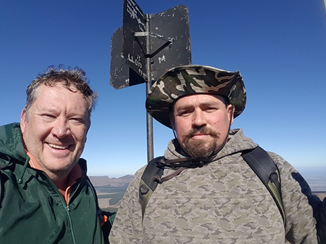
The saltmine has kept me from SOTA and playing radio in general, but when I told the XYL in March that the long weekend in June would be a SOTA weekend she agreed. She probably needs the quiet time as much as I do 😉The months and months between March and June saw me getting more and more excited about getting out of the office and into the mountains. Hennie (ZS2HC) was on standby (since March) and also keen. It was agreed we would meet in Hogsback and stay at the Swallowtail caravan park as our regular (Forresters House) was booked. The Swallowtail caravan park is over priced, unlevel, and offers campers no shelter from the wind. That said, it would be home from Friday midday to Monday morning. Swallowtail charges R140 pppn for a camp site.Time being the biggest resource constraint, we planned to do 4 summits in 2 days. A tall ask, but we had done them all before and now we knew some shortcuts.
The months and months between March and June saw me getting more and more excited about getting out of the office and into the mountains. Hennie (ZS2HC) was on standby (since March) and also keen. It was agreed we would meet in Hogsback and stay at the Swallowtail caravan park as our regular (Forresters House) was booked. The Swallowtail caravan park is over priced, unlevel, and offers campers no shelter from the wind. That said, it would be home from Friday midday to Monday morning. Swallowtail charges R140 pppn for a camp site.
Time being the biggest resource constraint, we planned to do 4 summits in 2 days. A tall ask, but we had done them all before and now we knew some shortcuts.
Friday I drove through to Hogsback leaving an hours or so later than I had initially planned – my day off was not a full day off, but the weekend was calling! The drive was long and the stop-go strips (near Fort Beaufort) were tedious.
Friday afternoon was spent with Hennie in the camp and making an early braai. Some Whisky was consumed (for medicinal purposes and to keep warm) and the evening was pleasant. We had set up a 160m dipole across the lawn of the caravan park (it was just about empty and I know why). We called but with no joy it was decided rather an early night for a big day awaited. Neither could sleep, so plan B was implemented. Pub-crawl through Hogsback village. Well I am sure there are places one could have gone that we missed, but the two place we visited proved worlds apart.
The first was a small pub in town next to the hardware store – called the Hog and something (didn’t read it on the way in and couldn’t on the way out). A single Whisky sets you back R15, the bar lady drinks red wine by the glass while she slowly drinks her patrons clever. After that Hennie insisted we go to “Away with the fairies” and have “one for the road”. It was of course almost 500m we had to travel, so a stop over was agreed. Away with the Fairies is a nice place to stay, but it is more of a “hippie” sort of camp where you pass out rather than the traditional (more structured) caravan park we had made our home.
We arrived just in time for the last round and took the drinks to the communal fire outside. Around the fire we chatted to a Scotish lass whos smile and bust negated the need for a name, and we eventually left there (having to wake the groundsman to let us out). A single Whisky here sets you back R37.50.
The wind on Friday night was gale force. The tent took it but flapped and flapped. Although we were warm and out of the wind, the night’s sleep was not as wonderful as it might have been.
Saturday morning after breakfast we headed off to conquer the Hog itself! Now I climbed the Hog last year with my son Graydon (ZU2GH) and it was an all day affair – from pre-dawn to after sunset. This time, however, we did not need to climb from Madonna and Child – we had found a road to the saddle just below the Hogs themselves – and this saved us hours and a LOT of effort. From a full day to a morning (and a bit) and that is what we call progress.
The afternoon saw us across town activating Menziesberg. It was great to “bump into” our old friend Gerald (ZS5GS). We also bumped into ZS6TAN, Mario who was banging out a great signal from ZS6 land – on World QRP day. Menzies is an easy one – really points for nothing compared to some other SOTA climbs around here, but is offers incredible views across the valley and the village.
Saturday evening saw us making a potjie and later again trying 160m. Ok, Hennie did the potjie and I worked 160m. Andrew Gray (ZS2G) heard me on 160m, but since I was using HIS dipole, he could only receive and that meant the scorecard for 160m contacts remained at an all time low of 0.
Sunday morning on Tor Doone is a sight to behold. Breathtaking beauty as you look back across the village toward Menzies where we had been the previous afternoon. Tor Doone holds a big spot in my heart – it was the first time I worked “DX” – I worked Namibia on 5w from a mountain top. An awesome feeling!
After Tor Doone it was “the big one”. Gaikaskop. We have only climbed Giakaskop once before, and that was on a very misty day and navigation was by GPS – step by step. I know you think we crazy, but we had checked where the cliffs and dangerous areas were on Google Earth and maps while still planning the trip, so it was not as dangerous as it might sound. On that occasion the view from the top was limited to say the least – and we had felt robbed of part of the reward. This time, however, there was no mist and the view was amazing. See pics below…(I have not posted the usual tons of pics for the other summits – you can catch them in past articles if you want to.)
Giakaskop climb starts from the abandoned fire lookout tower. From here you climb onto the saddle and then ascend from the back to arrive on top – a flat expanse of land you would never expect when you look at the cliff-face. An amazing view of Tor Doone “down there” tells us the view was awesome. See the pictures below…
Now I’m not one to complain much, but there is something that bugged me while on Gaikaskop. There we are – backs to the wind, lying down next to the base of the trig beacon with a simple wire dipole a few meters above the ground and we pumping out 5W. We calling CQ SOTA and mentioning QRP and there are a few stations who reply wanting to make contact with “the QRP station in Hogsback”. Each time we try call one of these stations, a certain ZS6 QRO station asks the other station if they can copy “the QRP station in Hogsback”. In spite of the other stations asking him to give us a chance, it takes nearly two and a half hours to get the required 4 contacts. We needed the contacts before we could pack up and get off the mountain. The other factor, of course, is that we do not have an endless supply of battery power either! As a general request, please, if you hear a
QRP/SOTA station, please give us a chance and DON’T talk all over us. There is a place for linear amplifiers, big rigs and super yagis, but there is a place for QRP too..We got off the mountain in time to see the sunset dipping behind the horizon and headed back, tired but relieved, to the campsite where we celebrated with a few beers, a fire, some meat and the rest of the whisky. ut break
Monday morning we packed up in the rain and headed our separate ways witho fast. Home safe and sound, we start planning the next thing!
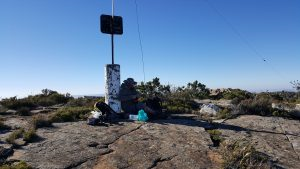
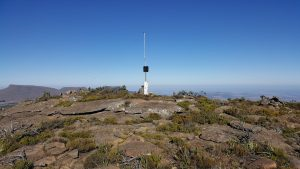
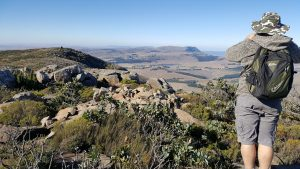

First time activation of
ZS/LP-053 Ga-Monaasenamoriri (Blouberg)
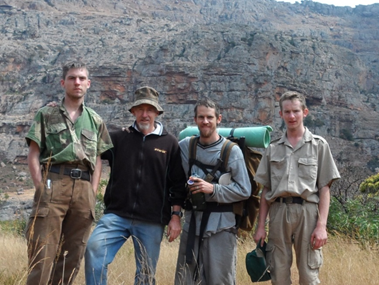
ZS6BV Brian Jones and his three sons, Eddie, Peter and Vernon.
On Friday 23 September 2017 at 03:30 UTC, carrying backpacks averaging 28kgs we started hiking from our vehicle which we left at Ga-Kibi village in Limpopo.
After a strenuous ten kilometer hike, including some near vertical rock scrambling, we arrived on the summit at 15:00 UTC in beautiful clear windless weather. The night was a brilliant display of stars and total quiet as we braaied our meat and fell into our sleeping bags long before normal bedtime.
On Saturday morning we set up the equipment and I began calling “CQ SOTA” while the boys hiked halfway down the mountain with a backpack of empty water bottles to fetch water.
I had many QSO’s on HF, local on 40 and 20m and DX on 20 and 15m including Summit to Summits with Sid ZS5AYC, Adele ZS5APT and Craig ZS5HAC who were on Mt Nebo in Mpumalanga and USA chases from Larry N7DD on 20m SSB and William N4LA on 15m SSB.
The wind got stronger and stronger through the afternoon, and I was forced to pack up the station.